Tulsi Every Day —
What Happens to Your Body When You Actually Stay Consistent
Most people try Tulsi tea once, feel vaguely calmer, then forget about it. What happens when you take it daily for 30, 60, and 90 days is a completely different story.
In Ayurveda, Tulsi is called “The Queen of Herbs” and “The Incomparable One.” Every part of it — leaf, seed, stem, root — is considered medicinal. It grows in the central courtyard of traditional Indian homes, tended daily as both a spiritual practice and a health ritual. Modern pharmacology has now confirmed over 30 distinct biological actions in its essential oil, phenols, and flavonoids. This is one of the most comprehensively active plants on earth.
Tulsi (Ocimum tenuiflorum) is classified as a Rasayana — Ayurveda’s category for herbs that promote longevity, youth, and exceptional wellbeing — and as an adaptogen. What makes it unusual among adaptogens is the breadth of its clinical evidence: blood sugar, cortisol, inflammation, immunity, cognition, and even cardiovascular markers have all been studied and confirmed in published trials.
There Are 3 Types of Tulsi — And They Are Not Interchangeable
The most common and widely available variety. Sweet, clove-like taste. Best for daily tea use, blood sugar support, and respiratory health. Most US supplements use Rama.
Daily WellnessRich in anthocyanins (the same antioxidants in blueberries). Stronger antimicrobial and anti-inflammatory profile. Traditional use for respiratory infections, skin conditions, and immune boosting.
Immune + SkinThe wild variety. Highest eugenol content — the compound responsible for Tulsi’s analgesic and anti-inflammatory properties. Best for pain, inflammation, and stress adaptation.
Pain + AdaptogensTri-Tulsi blends combining all three varieties are considered most comprehensive in Ayurveda — and are the form with the most complete modern research profile.
What Actually Happens — Day 7, Day 30, Day 60, Day 90
Tulsi’s cortisol-modulating action typically produces the earliest noticed effect: easier sleep onset and less waking through the night. This is the adaptogenic action beginning — the HPA axis responding to consistent ursolic acid and eugenol signalling from the herb.
Sleep onset improvementThe landmark 2012 study (Mondal et al.) found significant reductions in fasting blood glucose and improvements in insulin sensitivity at 30 days in diabetic patients taking 2.5g Tulsi leaf powder daily. Stress responses become noticeably less acute — not absent, but more manageable. Many women report less reactive anxiety at this point.
Blood sugar + stress responseC-reactive protein (a key inflammatory marker) shows measurable reduction at 60 days in published trials. Frequency of minor illness — colds, respiratory infections — typically decreases as Tulsi’s immunomodulatory compounds become consistently active. Skin often shows improvement at this stage as internal inflammation reduces.
Inflammation + immunityStudies at 90 days show improvements in memory, cognitive function, and metabolic rate. Lipid profiles (cholesterol, triglycerides) show measurable improvement in several trials — a long-term benefit most people don’t expect from a herbal tea. This is Tulsi’s Rasayana action at full development — the cumulative effect of consistent daily use building a more resilient physiological baseline.
Cognition + cardiovascularReduction in fasting blood glucose after 30 days of 2.5g daily Tulsi leaf powder (Mondal et al. 2012)
Decrease in cortisol response to standardised stress test in Tulsi extract group vs placebo (Singh et al. 2015)
Reduction in upper respiratory infection episodes over 3 months in Tulsi extract group (Mondal 2011)
Improvement in working memory score after 8 weeks of Tulsi in healthy adults (cognitive function trial, 2016)
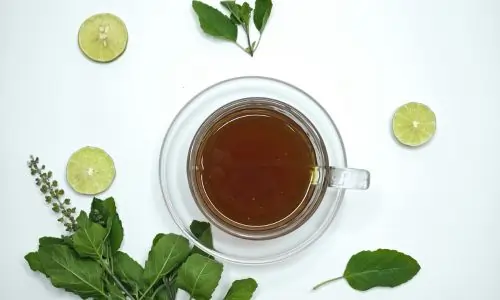
✦ How to Make Genuine Tulsi Tea — The Method That Works
Tea vs Capsules vs Tincture — Which Form Works Best?
Most complete profile of active compounds. Includes volatile essential oils not present in extracts. Best for stress, sleep, and daily adaptogenic use. Requires consistency and effort.
Most studied form in clinical trials. Predictable dosing, convenient, no preparation. Best for blood sugar, inflammation, and cognitive outcomes. Lacks volatile oil fraction.
Fast absorption. Good for immune and antimicrobial use. Alcohol extraction preserves different compounds than water. Less pleasant taste. Not ideal for blood sugar management.
Combines Rama, Krishna, and Vana for the broadest spectrum of compounds. Traditional Ayurvedic approach. Best overall option if choosing a single product for comprehensive benefit.
Frequently Asked Questions
Yes, for most people. Tulsi has been consumed daily in India as a household tonic for thousands of years without documented toxicity. Clinical trials lasting 3–6 months show good safety profiles with no significant adverse events. The only populations who should be cautious: pregnant women (Tulsi has historically been used as an emmenagogue in very large quantities), people on blood-thinning medication (Tulsi has mild antiplatelet action), and those with hypothyroidism (large doses may mildly affect thyroid function — moderate daily tea amounts are not a concern).
Indirectly — and meaningfully so for women. Tulsi reduces cortisol, and chronically elevated cortisol is one of the primary hormonal drivers of abdominal fat accumulation. By lowering cortisol consistently, Tulsi removes one of the hormonal obstacles to fat loss. It also improves blood sugar regulation and insulin sensitivity — another key factor in weight management that standard diet advice often overlooks. It is not a fat burner; it is a hormonal environment improver.
Yes — and this is one of the most consistently reported benefits among women who use Tulsi daily for 60+ days. Tulsi’s anti-inflammatory action reduces the internal inflammation that shows up as acne, redness, and dullness. Its blood purifying properties (clearing Ama in Ayurvedic terms) have a direct skin-clearing effect. The antioxidant load also provides protection against oxidative skin aging. These are gradual effects — most visible at 60+ days rather than weeks.
They target stress differently. Tulsi acts more broadly — cortisol, blood sugar, immune function, and inflammation are all part of the stress response it modulates. Ashwagandha goes deeper into the HPA axis with more potent cortisol suppression. For mild to moderate everyday stress, Tulsi tea daily is often sufficient and preferable for its gentler action and zero cycling requirement. For clinical anxiety, severe insomnia, or high-cortisol conditions, Ashwagandha extract provides stronger, more targeted intervention. Many women benefit from Tulsi tea daily plus Ashwagandha in cycles.
Find the Best Tulsi Products Available in the USA
We’ve compared tri-Tulsi blends, standardised extracts, and loose leaf teas — checking active compound concentration and sourcing transparency.
See Our Verified Tulsi Rankings →