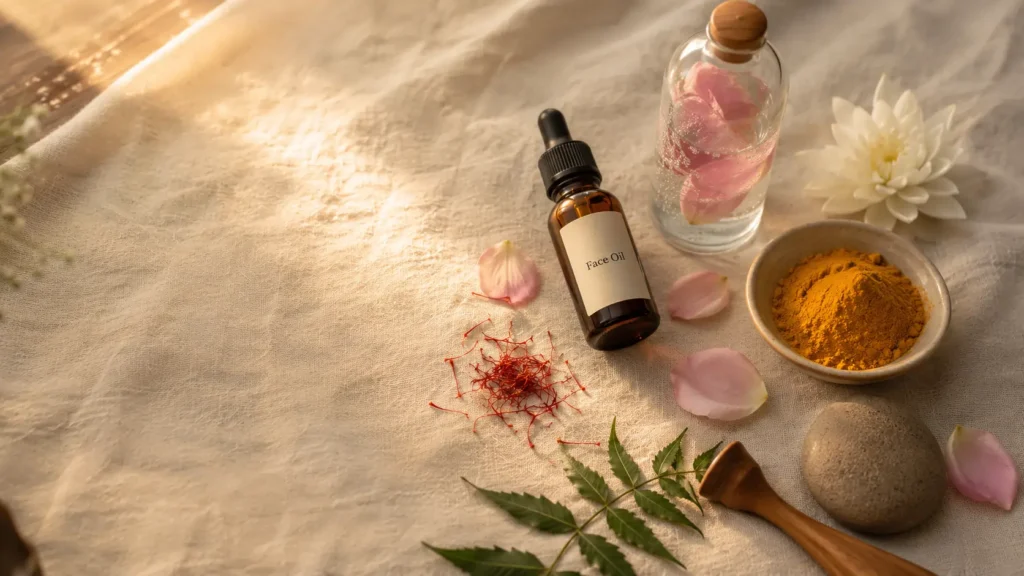
Ayurvedic Skin Care Routine for Glowing Skin: Morning & Night Guide
You don’t need a 12-step routine, a $200 serum, or a new shelf of bottles. Ayurveda has understood skin for thousands of years — through rhythm, simplicity, and a handful of intelligent botanicals. This guide walks you through a practical morning-and-night Ayurvedic skincare ritual, rooted in tradition and grounded in modern skin sense.
This is an educational article by eHealify. It does not constitute medical or dermatological advice. Always patch test new ingredients and consult a board-certified dermatologist for persistent skin concerns.
An Ayurvedic skin care routine for glowing skin centers on three things: gentle cleansing that respects the skin barrier, nourishing plant-based oils applied through light facial massage, and consistent daily timing aligned with your body’s natural rhythm. In the morning, the focus is on light hydration and sun protection. At night, richer oils and calming botanicals work while you sleep. Ingredients like saffron, turmeric, neem, rose, aloe, and kumkumadi-inspired face oils are the stars of this approach. Results build over 4–8 weeks with consistent use. Sunscreen is always the final morning step — no Ayurvedic ingredient replaces SPF.
Why Your Skin Might Not Be Glowing Right Now
If your skin looks dull, feels tight, or seems uneven in tone no matter what you apply — the problem is rarely one missing product. More often, it’s one or more of these patterns:
- Over-cleansing or stripping — harsh face washes disrupt the skin’s acid mantle and protective lipid barrier.
- Inconsistency — rotating products constantly prevents any ingredient from completing its work cycle.
- Wrong timing — applying rich oils in the morning under makeup traps heat; using acids without SPF worsens photosensitivity.
- Neglecting the inner layer — hydration and diet matter deeply for skin appearance, something Ayurveda has long emphasized.
- Layering too much — piling five actives creates irritation, not radiance.
- No sun protection — UV exposure is the number one environmental factor associated with uneven-looking skin tone and premature visible aging.
Ayurveda offers something modern multi-step routines often miss: intentional simplicity with intelligent ingredients.
The Ayurvedic View of Skin and Glow
In classical Ayurveda, glowing skin — called Prabha or Tejas — is not just a surface quality. It reflects the health of deeper tissues (dhatus), balanced digestion (agni), and harmony among the three doshas.
The three doshas and skin:
Most modern Americans have a mixed dosha profile — and the good news is that a general Ayurvedic glow routine works well across types, with minor ingredient swaps. Vata types lean toward richer oils; Pitta types prefer cooling botanicals like rose and sandalwood; Kapha types benefit from lighter oils and invigorating massage.
Two core Ayurvedic practices shape this routine:
- Dinacharya — a daily self-care rhythm aligned with the body’s natural clock. Skin care is part of the morning sequence, done intentionally and unhurriedly.
- Abhyanga — self-massage with warm oil. Applied to the face, this practice is thought to support circulation, lymphatic flow, and the skin’s natural moisture.
These are not rituals for luxury. They are Ayurveda’s version of a consistent, protective skin-care habit.
What Modern Skin Science Adds
Ayurvedic traditions and modern dermatology rarely contradict each other — they complement. Here’s what skin science confirms:
- The skin barrier is everything. A healthy stratum corneum retains moisture and keeps irritants out. Over-stripping (via harsh cleansers or excess exfoliation) visibly dulls skin and increases transepidermal water loss (TEWL). Plant-based oils rich in linoleic acid can help support barrier integrity.
- Hydration is visible. Well-hydrated skin reflects light more evenly, appears more plump, and looks more radiant. This is why aloe vera, rose water, and hyaluronic-adjacent botanicals appear in traditional skin rituals globally.
- Facial massage has studied benefits. Research published in peer-reviewed literature suggests that regular facial massage may improve local circulation, temporarily reduce puffiness, and contribute to a more even-looking complexion over time.
- Photosensitivity is real. Some botanicals — including turmeric, citrus-derived ingredients, and bergamot — can increase UV sensitivity. Always follow with SPF 30+ in the morning after using such ingredients.
- Sunscreen is not optional. The American Academy of Dermatology (AAD) consistently cites broad-spectrum sunscreen as the most evidence-supported daily skin-protective step available.
- Consistency beats intensity. Skin cell turnover takes roughly 28–40 days. No product “works overnight” — what works is a simple, consistent, non-irritating routine repeated daily.
Key Ayurvedic Ingredients for Glowing-Looking Skin
These botanicals have been used in Ayurvedic skin care for centuries. Their modern cosmetic safety profile is generally well-established, though individual reactions vary. Always patch test.
Traditionally used to support the appearance of brighter, more even-looking skin tone. Often infused into face oils. Use in trace amounts — a pinch in a tablespoon of base oil. Evidence is limited but traditional use is centuries-deep. May increase UV sensitivity; use at night or follow with SPF.
A celebrated Ayurvedic ingredient with curcumin as its active compound. Traditionally applied in face masks to support a clearer-looking complexion. Can temporarily tint fair skin yellow — use in diluted form (1/4 tsp in a mask or carrier oil). Some studies suggest anti-inflammatory properties; clinical skin evidence is still growing.
Traditionally used as a gentle, purifying botanical for congested or combination-looking skin. Often found in cleansers and face washes. Has a strong odor; typically blended with other botanicals. May support the look of clearer skin. Patch test if you have sensitive skin — can be drying in concentrated form.
Rose water is used in Ayurveda as a gentle toner and hydrating mist. Traditionally cooling for Pitta-dominant skin. Provides a light layer of surface hydration and a pleasant aromatic experience. Generally very well-tolerated. Look for pure distilled rose water without synthetic fragrance.
One of the best-studied botanical skin ingredients. Aloe gel is a lightweight humectant that helps the skin appear more hydrated and calmed. Used in Ayurveda for soothing irritated skin. Safe for most skin types; choose fragrance-free, minimally processed aloe gel. Not a replacement for moisturizer for very dry skin.
Traditionally used internally and topically in Ayurveda to support the look of even skin tone. Often found in specialty Ayurvedic face serums and oils. Clinical topical evidence is limited; described in traditional texts as supporting the appearance of a more radiant complexion. Approach as a complementary, not corrective, ingredient.
A traditional polyherbal Ayurvedic face oil containing saffron, sandalwood, lotus, and other botanicals in a sesame oil base. Traditionally used for skin that looks dull, uneven in tone, or dry. Used in 2–3 drop amounts at night. Not for acne-prone or oily skin without guidance — sesame oil can be comedogenic for some. Patch test is essential.
Traditionally used in Ayurveda as a cooling, aromatic ingredient for Pitta skin. Often found in face packs and face oils. Provides a calming aromatic effect and is thought to support the look of smooth, even skin. Authentic sandalwood is expensive; ensure the product is genuine. Essential oil must be diluted before skin use.
The Ayurvedic Morning Skin Care Routine for Glowing Skin
The morning routine is intentionally lighter. Ayurveda teaches that morning is Kapha time — slightly cool, still, and slow. A simple, nourishing morning ritual protects the skin for the day ahead without overloading it.
Splash with lukewarm water
Ayurveda traditionally begins with rinsing the face with lukewarm (not hot) water. Hot water strips the skin’s natural oils. This simple step removes overnight buildup without disrupting the barrier.
Skip morning cleansers unless you sweat heavily at nightRose water mist or toning
Spritz or gently pat pure rose water onto slightly damp skin. This provides a light veil of surface hydration and helps prep the skin for the next step. Look for additive-free rose water with no synthetic fragrance.
Pat — don’t rub — for best absorptionLightweight facial oil or moisturizer
Apply 2–3 drops of a lightweight face oil (rosehip, sweet almond, or a light kumkumadi blend) or your regular moisturizer. Use gentle upward strokes — the beginning of your morning abhyanga. For oily skin, aloe gel works well here instead of oil.
Warm oil between palms before pressing onto skinGentle facial massage — 1–2 minutes
Using fingertips, massage in small upward circles along the jaw, cheeks, and forehead. Gently press along the brow bone and around the eyes (no pulling). This is the dinacharya face massage practice — thought to support circulation and a more awake-looking complexion.
Direction: always upward and outwardBroad-spectrum SPF 30 or higher — always last
This is the most important step in any morning skincare routine, Ayurvedic or otherwise. Apply a broad-spectrum sunscreen as the final morning step, every single day. No botanical ingredient replaces this protection. The AAD recommends SPF 30 minimum for daily use.
Wait 2–3 minutes after oil absorbs before applying SPFThe Ayurvedic Night Skin Care Routine
Evening is Pitta time in Ayurvedic tradition — when the body’s internal “fire” processes and repairs. This is when richer, more nourishing Ayurvedic ingredients can be used without sun-exposure concerns. The night ritual focuses on cleansing the day’s buildup, feeding the skin barrier, and allowing botanical oils to work uninterrupted.
Oil cleanse or gentle herbal cleanser
Start with a plant-oil based cleanser — almond oil, coconut oil (for non-acne-prone skin), or a formulated Ayurvedic cleansing milk — to dissolve sunscreen and the day’s impurities. If wearing makeup, this is your first cleanse. Follow with a gentle neem-based or soap-free second cleanser if needed.
Double cleanse only on heavy makeup or sunscreen daysAyurvedic weekly face mask (2x per week)
A simple Ayurvedic mask: mix a pinch of turmeric with a teaspoon of chickpea flour (besan) and enough rose water or honey to form a paste. Apply for 10–12 minutes, rinse with lukewarm water. Traditionally thought to support a clearer, more even-toned appearance. Do not scrub off — rinse gently.
Use on non-consecutive nights; not dailyRose water or aloe vera — hydrating layer
After cleansing, apply rose water mist or a thin layer of plain aloe vera gel to slightly damp skin. This creates a hydrating base that helps the subsequent oil layer absorb more effectively — the “damp skin” method that modern skin science supports for better moisture retention.
Skin should feel dewy, not dripping wetAyurvedic face oil — 2–3 drops
This is the centerpiece of the night ritual. Apply 2–3 drops of a Kumkumadi-style face oil, rosehip oil, or a saffron-infused almond oil to the palms, warm between hands, and press gently onto the face and neck. Less is more — a thin layer is enough. Rich in fatty acids and fat-soluble botanicals, this step nourishes the skin barrier while you sleep.
2–3 drops only; excess oil can cause congestionNight abhyanga facial massage — 3–5 minutes
Work the oil in with deliberate, slow upward strokes. Sweep along the jawline and neck, circle the cheeks and temples, and use gentle pinching along the brow. Finish with soft cupping strokes across the forehead. This is your evening ritual — slow, intentional, and restorative. It may help your skin appear more awake and smoother by morning.
Finish by gently pressing both palms flat against cheeks — hold 10 secondsWeekly Ayurvedic Ritual
Once a week: A gentle exfoliation using a natural grain-based scrub — chickpea flour (besan) mixed with a few drops of milk or rose water — can support the skin’s natural cell-shedding cycle. Massage gently for 60 seconds; do not scrub aggressively. This is not the same as a chemical exfoliant — it is much gentler and suitable for most skin types with patch testing.
Once a week: A longer facial massage (5–7 minutes) with slightly warmed sesame or almond oil before a warm shower. Allow 15 minutes for the oil to absorb into the skin before rinsing with a gentle cleanser.
Note: Avoid over-exfoliating. If you already use a retinoid, AHA, or BHA from a dermatologist, consult them before adding any Ayurvedic scrubs.
7 Common Mistakes in Ayurvedic Skincare Routines
- Using raw turmeric directly on the face in large amounts
Concentrated turmeric can stain, irritate, and cause photosensitivity. Always dilute in a carrier oil or mask base — a pinch is enough.
Do this instead: Use cosmetic-grade turmeric in a diluted mask, 1–2x per week, followed by SPF if going outdoors. - Skipping sunscreen because “it’s a natural routine”
No botanical ingredient, however revered, offers clinically meaningful UV protection. Skipping SPF worsens uneven tone and dulls the skin over time.
Do this instead: Apply SPF 30+ as the final morning step — every single day, regardless of season or cloud cover. - Using too much face oil
More oil is not more glow. Excess oil traps heat, clogs pores for some skin types, and leaves an uncomfortable residue.
Do this instead: 2–3 drops, warmed between palms, pressed onto damp skin. That is the correct amount for the entire face. - Trying every new Ayurvedic ingredient at once
Adding saffron, turmeric, neem, sandalwood, and manjistha all in one week makes it impossible to know what is working — and what is causing a reaction.
Do this instead: Introduce one new ingredient at a time. Give each at least 2–3 weeks before evaluating. - Aggressive facial massage technique
Pulling, tugging, or pressing hard on the delicate skin around the eyes causes mechanical stress that can worsen the appearance of fine lines over time.
Do this instead: Use ring fingers with the lightest possible pressure around the eye area; no dragging. - Expecting dramatic results in 3–5 days
Ayurvedic skin care is a long-term investment. Skin turnover takes 28–40 days. Expecting “overnight glow” leads to abandoning routines before they have a chance to work.
Do this instead: Commit to 60–90 days of consistent practice. Take a photo on day 1 and day 60 to notice gradual changes. - Ignoring internal factors
Ayurveda places skin health firmly within overall body health. A skin routine applied over poor sleep, a low-water diet, or chronic stress will produce limited results.
Do this instead: Pair your skin ritual with adequate water intake, at least 7 hours of sleep, and a diet rich in vegetables and healthy fats.
Myths vs Facts: Ayurvedic Skincare
| Myth | Fact |
|---|---|
| “Natural always means safe for your skin.” | Natural ingredients can cause allergic reactions, photosensitivity, irritation, and clogged pores in some people. Patch testing is always required, regardless of “natural” labeling. |
| “More layers of oil give more glow.” | Excess oil can sit on the skin surface without absorbing, potentially contributing to congestion. 2–3 drops applied to damp skin is optimal for most face oils. |
| “Ayurvedic skin care and modern dermatology are incompatible.” | They complement each other well. An Ayurvedic oil routine can coexist with a prescription retinoid or dermatologist-recommended skincare — just don’t layer them simultaneously. Consult your dermatologist. |
| “Turmeric will give you glowing skin in one week.” | Turmeric may support a clearer-looking complexion over time, but no ingredient produces dramatic results in a week. Consistent use over 8–12 weeks is a more realistic timeframe. |
| “You don’t need sunscreen if you use an Ayurvedic routine.” | Absolutely incorrect. No Ayurvedic ingredient offers meaningful UV protection. SPF is required every morning, even for purely botanical routines. |
| “Kumkumadi oil is good for every skin type.” | Kumkumadi tailam is typically sesame oil-based and polyherbal. It may not suit oily, acne-prone, or very sensitive skin. Individual results vary significantly. Patch test and consult a professional if unsure. |
Is This Routine Right for You?
- Normal to dry skin types
- Dull-looking, dehydrated skin
- Vata-dominant constitutions
- Clean beauty enthusiasts
- Those new to facial massage
- Mature, dry-looking skin
- Beginners to face oils
- Those seeking a mindful routine
- Acne-prone / breakout-prone skin
- Very oily skin types
- Active cystic acne
- Rosacea or extremely reactive skin
- Known nut or plant oil allergy
- Currently using strong prescription actives
Frequently Asked Questions
What is an Ayurvedic skin care routine for glowing skin?
An Ayurvedic skincare routine uses plant-based ingredients and traditional rituals — like cleansing with neem, moisturizing with face oils, and gentle facial massage — to support the skin’s natural balance and help it appear more radiant over time. The approach is rooted in dinacharya (daily rhythm) and centers on ingredients like saffron, rose, turmeric, aloe, and kumkumadi oil.
How long does it take to see results from an Ayurvedic skincare routine?
Most people notice improvements in skin hydration and texture within 4–6 weeks. Visible changes in skin tone and radiance may take 8–12 weeks with consistent daily use. Skin cell turnover takes roughly 28–40 days, so any routine needs at least that long to show meaningful change. Results also depend on diet, sleep, water intake, and overall health.
Can Ayurvedic skincare work for oily or acne-prone skin?
With care, yes — but the ingredient selection changes significantly. Heavy oils like sesame and coconut should be avoided or used very sparingly. Lighter options like jojoba, rosehip, or diluted neem are better suited. Avoid rich masks and heavy oil layers. If you have active acne, consult a dermatologist before making changes to your topical routine.
Is turmeric safe to use on the face every day?
Daily turmeric application is generally not recommended in its concentrated form due to staining risk (especially on fair skin) and potential irritation with repeated use. Using a diluted turmeric mask 1–2 times per week is a more appropriate frequency. Always follow morning applications with SPF, as turmeric may increase UV sensitivity.
What Ayurvedic oils are best for glowing skin?
Kumkumadi oil is the most celebrated traditional Ayurvedic face oil. Other commonly used options include rosehip seed oil (rich in linoleic acid), saffron-infused sweet almond oil, and sesame oil for dry/Vata-type skin. Apply 2–3 drops to clean, slightly damp skin at night. Patch test before use and avoid heavy oils if your skin is prone to breakouts.
Do I still need sunscreen with an Ayurvedic skincare routine?
Yes — without exception. Sunscreen (SPF 30 or higher, broad-spectrum) is the final and most important step in any morning skin routine. No botanical ingredient, including those revered in Ayurveda, offers clinically meaningful UV protection. The American Academy of Dermatology recommends daily sunscreen for all skin types, year-round.
What is Kumkumadi oil and is it suitable for everyone?
Kumkumadi tailam is a traditional polyherbal Ayurvedic face oil containing saffron, sandalwood, lotus petal, and other botanicals in a sesame oil base. Traditionally used to support a more radiant, even-looking complexion. It is generally suited to dry, dull, or normal skin. Those with oily or acne-prone skin should patch test carefully, as sesame oil can be comedogenic for some. Always verify product ingredient quality before purchasing.
Can I do facial massage every day?
A gentle, brief facial massage (2–5 minutes) can be performed daily, typically during your evening oil step. Use light upward strokes, avoid aggressive pulling around the eyes, and work with clean, oil-covered hands. Do not massage over active breakouts or inflamed skin. Many people find a daily evening face massage supports a more relaxed, nourished appearance over time.
Final Thoughts: Glow Is a Practice, Not a Product
The most powerful thing about Ayurvedic skincare is not any single ingredient — it’s the principle of consistent, intentional daily care. A two-minute morning ritual done every day for 60 days will almost always outperform a $150 serum used twice a month.
Start simple: rose water, aloe, two drops of a quality face oil at night, and broad-spectrum SPF every morning. Build your routine slowly. Patch test everything. Trust the rhythm more than the result.
Your skin is not a problem to solve — it’s a system to support. Ayurveda has always understood that. And increasingly, skin science is agreeing.
Remember: this guide is for educational purposes. It does not replace the advice of a licensed dermatologist. If you have a diagnosed skin condition or are currently under dermatological care, consult your physician before making changes to your routine.
Sources & Research References
- American Academy of Dermatology Association (AAD) — Sunscreen FAQs and daily skin care recommendations. aad.org
- National Center for Complementary and Integrative Health (NCCIH), NIH — Ayurvedic Medicine overview. nccih.nih.gov
- Pulok K. Mukherjee et al. — “Traditional and Complementary Medicine for Skin,” peer-reviewed review discussions on Ayurvedic botanicals including Kumkumadi, Manjistha, and Turmeric. Published in various peer-reviewed Ayurvedic pharmacology journals.
- Surjushe A, Vasani R, Saple DG — “Aloe vera: A short review.” Indian Journal of Dermatology, 2008. PubMed ID: 19841695.
- Hewlings SJ, Kalman DS — “Curcumin: A Review of Its Effects on Human Health.” Foods, 2017. PubMed ID: 28930049.
- Loden M — “The skin barrier and use of moisturizers in atopic dermatitis.” Clinics in Dermatology, 2003. (Skin barrier and emollient research reference.)
- Cleveland Clinic — “Skin Care Basics: Moisturizing and Barrier Support.” clevelandclinic.org
- Caberlotto E et al. — “Effects of a skin-massaging device on the ex-vivo expression of human dermis proteins…” Scientific Reports, 2017. (Facial massage and circulation research.)
- Charaka Samhita and Sushruta Samhita — Classical Ayurvedic texts referenced for traditional ingredient use and dinacharya principles. (Traditional text, pre-modern era.)
- FDA — Cosmetic ingredient labeling and safety guidance. fda.gov/cosmetics
Note: Traditional Ayurvedic ingredient references reflect centuries of documented use; they are not equivalent to modern randomized clinical trial evidence. Where clinical evidence is limited, eHealify uses appropriate cosmetic language (e.g., “may support the appearance of…” rather than “treats” or “cures”).


Archana R.
Archana explains Ayurvedic traditions, herbal wellness, sleep, stress, and clean living in approachable language for modern women.
Follow on PinterestHave a personal routine or lesson to share?
Send your skincare, hair care, product, or Ayurveda-inspired experience for review. Selected stories are edited for clarity, safety, and permission before publishing.
Submit a story for review