The Ancient Herbs That Have Been Giving Indian Women Glowing Skin for 5,000 Years
No lab, no chemicals. Just 20+ botanicals that nature — and Ayurveda — perfected long before skincare became an industry.
Your Skin Has a Clock. Ayurveda Figured That Out 5,000 Years Ago.
If you’ve ever woken up with skin that just glows — dewy, even, alive — you know that feeling is real. It’s not marketing. And according to Ayurveda, that glow isn’t a product you buy. It’s a state your body produces when it’s in balance, nourished from the inside and outside with the right botanicals at the right time.
Ancient Indian physicians — called Vaidyas — spent centuries observing how specific plants interact with human skin. They noticed that saffron brightened. That turmeric calmed. That Indian Madder restored. They recorded these findings in texts called the Charaka Samhita and Sushruta Samhita, and those formulations are still used today — just with modern science catching up to confirm what they observed.
“Skin is not just a surface. In Ayurveda, it’s a mirror of your internal health — and the herbs you choose should nourish both.”
🌀 A Quick Ayurveda 101
Ayurveda teaches that everything in nature — including your skin — is governed by three life forces called doshas: Vata (air + space), Pitta (fire + water), and Kapha (earth + water). Dry, flaky skin? Likely Vata imbalance. Oily, congested, inflamed skin? Pitta. Puffy, dull, sluggish skin? Kapha. The herbs in this guide work precisely because they address these root imbalances — not just surface symptoms.
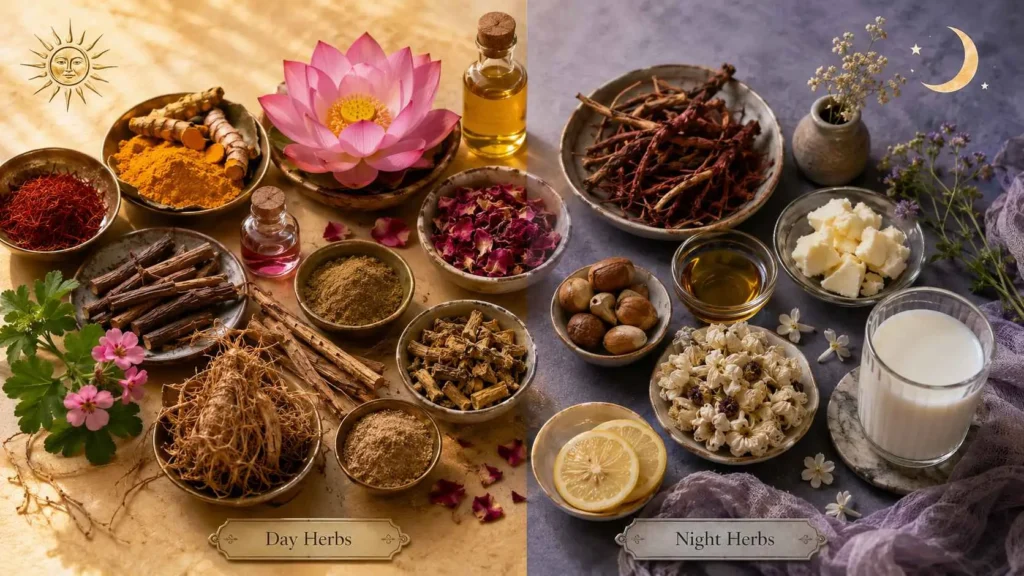
Below, we’ve broken down 20+ herbs organized into morning (brightening + protecting) and nighttime (restoring + purifying) categories, because Ayurveda has always believed different herbs work best at different times. Your skin follows a circadian rhythm. These herbs work with it.
The Day Herbs — Brighten, Protect & Nourish
These botanicals are your morning allies. They protect your skin from environmental exposure, bring a visible radiance, even out tone, and keep skin moisturized through the day. Use them in your daytime routine — either infused in oils, in face masks, or as herbal tonics.
The most expensive spice on Earth isn’t just for cooking. The stigma of the saffron flower contains crocin and crocetin — potent antioxidants that have been studied for their ability to inhibit melanin production, which means they actively work against the dark spots and uneven pigmentation that make skin look tired. In Ayurveda, saffron is called Varnya — a class of herbs specifically known to enhance skin complexion and luster. A 2013 study published in the Journal of Ethnopharmacology confirmed its potent anti-melanogenic (anti-darkening) properties. It also carries significant anti-inflammatory benefits, calming skin that’s reacting to pollution, stress, or hormonal changes.
A classic Ayurvedic application is saffron-infused oil or milk: steep 4–5 saffron threads in 1 tablespoon of warm raw milk for 20 minutes, then apply as a face mask for 15 minutes. Used in facial oils at concentrations of 0.5–2%. Consistency over 4–6 weeks produces visible brightening effects.
Science has written over 10,000 peer-reviewed papers on turmeric. The active compound curcumin is one of the most well-studied natural anti-inflammatories in existence. For skin, this translates to: calmer redness, reduced post-blemish marks, brightened dullness, and protection against UV-triggered damage. In Ayurveda, turmeric has been used for Kushtha (skin disorders) for millennia. It inhibits an enzyme called tyrosinase — the same enzyme targeted by expensive brightening serums — making it a natural, gentler alternative for hyperpigmentation.
The classic Ayurvedic ubtan (facial paste) combines 1/4 teaspoon turmeric with 2 tablespoons chickpea flour and enough raw milk to form a paste. Applied twice weekly, it brightens and refines texture. In oil infusions: 1 teaspoon dried turmeric per 100ml carrier oil, cold-infused for 4 weeks. Tip: Kasturi turmeric (Curcuma aromatica) doesn’t stain skin the way culinary turmeric can.
Manjishtha is arguably Ayurveda’s single most important herb for skin — and it appears in formulations for both day and night use. The root of this creeping plant gives a natural deep pink color, and its compounds rubiadin and alizarin have demonstrated antioxidant, anti-inflammatory, and skin-brightening activity in scientific research. Its most remarkable quality in Ayurveda is being a powerful rakta shodak — a blood and lymph purifier. Since the lymphatic system is responsible for clearing cellular waste from skin tissue, manjishtha works from the ground up to give skin clarity from within. It’s particularly known for addressing post-acne marks, uneven patches, and tired, congested complexions.
Internally: 1/4 to 1/2 teaspoon of manjishtha powder in warm water or honey daily is a classical Ayurvedic blood-purifying tonic. Topically: Used as a paste with honey (1 tsp powder + 1 tsp honey) applied for 20 minutes. In oil, 10–15% herb-to-oil ratio in a cooked classical preparation.
Licorice root is one of the most science-backed natural brighteners in existence. Its active compound glabridin has been shown in multiple clinical studies to inhibit melanin synthesis more effectively than kojic acid — a common ingredient in brightening products. Another compound, liquiritin, disperses existing melanin in skin, which means it actively fades dark spots already formed. In Ayurveda, licorice is classified as a Varnya herb — one that gives the skin a fair, clear appearance. It’s also deeply anti-inflammatory and soothing, making it excellent for sensitive or reactive skin types.
Topically: Steep 2 tablespoons of licorice root powder in 1 cup of boiling water for 15 minutes. Cool and use as a toner or face rinse. As a mask: mix 1 tsp licorice powder with aloe vera gel and apply for 20 minutes, 3x weekly. Scientific studies suggest visible results with consistent 4% concentration topical application over 4 weeks.
The lotus is sacred in Hinduism — and it turns out there’s a very practical reason ancient Indian physicians used it in skin preparations. Lotus flower extract is rich in flavonoids, alkaloids, and Vitamin C, making it a powerful antioxidant and brightening agent. It also contains mucilage — a natural substance that forms a moisture-retaining film on skin, reducing transepidermal water loss. Studies show lotus extract inhibits MMP enzymes that break down collagen, meaning it helps skin maintain its firmness and youthful appearance over time.
Lotus petal face mist: simmer 2 tablespoons of dried lotus petals in 1 cup distilled water for 10 minutes. Cool, strain, and use as a facial spray or toner. Can also be mixed with rose water 1:1 for a hydrating toner used morning and night.
Rose oil has been used in Ayurvedic formulations since at least 600 BCE. The compound geraniol and citronellol in rose oil are potent antioxidants that protect skin cells from oxidative damage. Rose is deeply Pitta pacifying — cooling inflamed, reactive, or sensitive skin. It’s also one of the best natural humectants, drawing moisture into the skin and locking it there. A 2011 study in the International Journal of Molecular Sciences confirmed rosa damascena extract’s ability to protect against UV-induced damage and collagen degradation. Beyond the science, the scent of rose is clinically shown to lower cortisol levels — and cortisol is a major trigger for skin inflammation and breakouts.
Rose water (distilled rose hydrosol) is the simplest, most accessible form. Use as a morning toner after cleansing. For a classical Ayurvedic face oil: add 2–3 drops of pure Rosa damascena essential oil per 10ml of sesame or jojoba oil. Use morning and evening.
Vetiver root has a deep, earthy fragrance that’s been prized for centuries — but its skincare benefits are just as remarkable as its scent. In Ayurveda, vetiver is one of the primary Pitta-pacifying herbs, known for its deeply cooling, anti-inflammatory nature. Modern research has identified khusimol and isovalencenol as its active compounds, with demonstrated antimicrobial and sebum-regulating properties. For skin, this means reduced pore appearance, less excess oil, and refined texture. It’s particularly beneficial for women with oily or combination skin in warm climates.
Vetiver-infused water (Ushira water) has been used as a summer face rinse for centuries: soak 2 tablespoons of dried vetiver roots in 1 liter of water overnight. Strain and use as a face rinse in the morning. Can also be added to face packs (1 tsp powder) to tighten pores and cool skin.
Nut grass rhizome may sound unglamorous, but it’s one of Ayurveda’s secret weapons for skin brightening. Its key compound cyperene inhibits melanin production, making it valuable for addressing hyperpigmentation, sun spots, and post-inflammatory marks. A 2011 study in Planta Medica found nut grass extract inhibited UVB-stimulated melanin synthesis. In Ayurveda, it’s classified as both Varnya (complexion-brightening) and Tvachya (skin-nourishing), meaning it improves both tone and texture simultaneously.
Used as a paste (1 tsp nut grass powder + rose water) applied to areas of hyperpigmentation for 20 minutes, 3–4 times per week. In oil infusions, combined with turmeric and saffron for a comprehensive brightening blend at 10% concentration.
Lodhra bark is one of the most powerful natural astringents in Ayurveda. Its tannins and alkaloids (loturine, loturidine) tighten pores, firm sagging skin, reduce excess sebum, and calm inflamed skin. In Ayurvedic gynecological texts, lodhra is specifically recommended for women’s skin health. Modern studies have validated its ability to reduce skin oiliness and the appearance of enlarged pores. It’s particularly effective for the T-zone and for women experiencing hormonal changes that affect skin laxity.
Lodhra face pack: 2 tsp lodhra powder + 1 tsp honey + enough rose water to form a paste. Apply and leave for 20 minutes before washing off. Use 2–3 times per week for visible pore refinement within 3–4 weeks.
Indian Barberry contains one of the most studied plant compounds of our time: berberine. Berberine has remarkable anti-inflammatory, antimicrobial, and anti-melanogenic properties. For skin, this means it addresses blemishes, reduces post-acne marks, inhibits excess melanin production, and keeps breakout-causing bacteria in check. In Ayurveda, it’s often used alongside turmeric for skin disorders, amplifying the brightening and healing effects of both.
Traditionally, barberry stem is boiled and the decoction used as a face wash for oily, blemish-prone skin. As a targeted spot treatment: make a paste of barberry powder with neem water and apply to blemishes or dark spots. Use 2–3 times per week.
🔬 What Science Says About These Day Herbs
A 2020 review published in the Journal of Ayurveda and Integrative Medicine confirmed that the Varnya gana (complexion-brightening group of herbs) in Ayurveda — which includes saffron, nut grass, lotus, and licorice — all demonstrate measurable tyrosinase inhibition (reducing melanin formation) in laboratory conditions. The synergy of using them together in an oil base appears to amplify individual effects, which is why classical Ayurvedic formulations combine many herbs rather than isolate single actives.
In Ayurveda, the choice of base oil is as important as the herbs infused in it. Sesame oil is considered the king of base oils — and not without reason. It has a natural SPF of approximately 4–6 (not a sunscreen replacement, but meaningful protection). It contains sesamol and sesamin — potent antioxidants with UV-filtering properties. It penetrates deeply through the skin layers rather than sitting on the surface, carrying whatever herbs are infused in it to deeper tissue. It’s also deeply Vata-pacifying, meaning it nourishes and prevents dryness while balancing skin that tends toward dehydration.
For a simple Ayurvedic face oil: use cold-pressed, unrefined sesame oil as your base. 3–5 drops warmed in the palm of your hand and massaged upward into face and neck is the traditional morning application method after cleansing.
Geranium is one of the few botanicals that regulates sebum production — making it uniquely helpful for both oily and dry skin. It balances rather than strips or over-moisturizes. Its primary active geraniol is a potent antioxidant with demonstrated anti-inflammatory activity. In aromatherapy, geranium is used to balance hormones — relevant for the millions of women whose skin changes with their cycle, perimenopause, or stress. Studies show geranium oil’s antimicrobial properties are effective against Staphylococcus aureus, a common blemish-triggering bacteria.
In facial oil: 2 drops of geranium essential oil per 10ml carrier oil. Or add 3 drops to your regular facial moisturizer. Can be diffused in a room steam bowl for a skin-benefiting facial steam alongside chamomile flowers.
The Night Herbs — Purify, Restore & Renew
While you sleep, your skin enters its deepest repair cycle. Cell turnover doubles at night. Blood circulation to the skin increases. These Ayurvedic herbs are designed to work with that process — purifying lymph and blood, removing stagnation, and waking up a clear, even, rested complexion by morning.
At night, manjishtha works at its deepest level. Ayurvedic texts identify it as a rakta prasadana herb — one that purifies and nourishes the blood, which in turn means cleaner, clearer skin over time. The lymphatic system does most of its cleaning work during sleep, and manjishtha’s compounds support that process. Applied topically during the night, its alizarin and rubiadin compounds have time to work their antioxidant, anti-inflammatory, and anti-melanogenic effects undisturbed. It’s particularly powerful for women who notice skin looks more congested, puffier, or uneven with hormonal fluctuations.
Classic Ayurvedic night mask: 1 tsp manjishtha powder + 1 tsp honey + a pinch of turmeric. Apply for 30 minutes or overnight on specific areas. For overnight oil: infuse manjishtha in sesame oil (2 tbsp herb per 100ml oil) and use 3–5 drops nightly.
Mahua bark is less well-known in Western beauty circles but deeply valued in Ayurveda for its remarkable ability to restore the skin’s protective barrier. The bark contains saponins and tannins that have anti-inflammatory and barrier-repairing properties. The mahua flower itself yields a butter-rich oil (similar in profile to shea butter) loaded with oleic and stearic acids that prevent moisture loss overnight. For women experiencing perimenopausal skin changes — thinning, dryness, loss of elasticity — mahua is especially beneficial because of its deep, lasting moisturizing action that works during the skin’s natural overnight repair window.
Mahua butter or oil can be applied directly to dry areas of the face, neck, and décolleté at night. 1–2 drops of mahua oil mixed into your regular night oil blend provides deep occlusive moisture. The bark decoction (2 tbsp bark boiled in 2 cups water, reduced by half) can be used as a skin-tightening facial rinse before nighttime oil application.
Lemon juice has been used in Indian beauty rituals for centuries — and there’s very good science behind it. Lemon contains Vitamin C (a proven brightener that boosts collagen and inhibits melanin), citric acid (a natural alpha-hydroxy acid that gently exfoliates dead skin cells revealing fresher skin beneath), and limonene (an antioxidant). The reason it’s a nighttime-only herb is important: citric acid increases photosensitivity if used in the day when exposed to UV light. At night, however, it works safely and effectively — dissolving dead cell buildup and visibly brightening complexion over time. This is ancient wisdom that mirrors modern AHA skincare science perfectly.
Always dilute: mix 1 part fresh lemon juice with 3 parts rose water or aloe vera gel. Apply to face, wait 10–15 minutes, rinse. Never apply full-strength lemon directly to skin — the natural acid can cause irritation or sensitivity. Do a patch test. Start with once weekly and increase if skin tolerates well. Always follow with moisturizing oil to prevent over-drying.
Cleopatra bathed in milk. Indian queens used raw milk as a nighttime face mask for centuries. The lactic acid in milk is a natural AHA — gently dissolving dead skin cells, brightening dullness, and smoothing uneven texture. Milk also contains Vitamin D, B vitamins, and natural proteins (casein and whey) that nourish skin cells. In Ayurveda, cow’s milk is considered deeply Ojas-building — it promotes a luminous quality called tejas (inner radiance) when used consistently both internally and externally. It’s one of the most gentle brightening agents available, making it ideal for sensitive skin types.
The simplest Ayurvedic night treatment: apply raw whole milk to your face with a cotton pad, leave for 20 minutes, rinse with cool water. For a brightening soak: mix equal parts raw milk and rose water as a face rinse every evening for 2 weeks. Combine with a pinch of saffron (4–5 threads) for an amplified brightening effect.
The Supporting Cast — Equally Powerful
These additional herbs from classical formulations each bring unique benefits that round out a complete skin-glow protocol:
Used in Ayurvedic classics as a Varnya (complexion) herb, this Himalayan tree bark contains prunasin and tannins that have anti-inflammatory and skin-soothing properties. It’s particularly effective at calming reactive, blotchy skin and helping uneven tone become more uniform. Studies show its bark extract inhibits pro-inflammatory cytokines — the molecular cause of skin redness and inflammation.
The flower of the Mesua ferrea tree yields mesuol and xanthones with potent antioxidant and astringent properties. In Ayurveda it’s used to tone and firm skin, reduce excessive sweating (beneficial for oily skin), and as an anti-aging botanical. Its compounds inhibit collagen-degrading enzymes, making it valuable for maintaining skin structure and firmness over time.
The orange-red flowers of this striking tree contain butein and butin — flavonoids with documented antioxidant, anti-inflammatory, and anti-melanogenic activity. In Ayurvedic skin texts, it’s used to address dark spots, freckles, and uneven pigmentation. Research has confirmed its ability to inhibit melanogenesis. It’s also traditionally used to address parasitic skin conditions and as a wound healer.
The bark of India’s national tree contains bengalenoside and tannins that are deeply astringent, toning, and anti-aging. In Ayurveda, banyan bark is used for vranaropana (wound healing) and to firm sagging or loose skin. Its silica content supports collagen formation, and its strong astringency makes it effective for reducing pore size and tightening skin that has lost elasticity. Particularly beneficial for women noticing skin laxity after 35.
Sweet flag rhizome contains beta-asarone and calamenol, compounds with strong anti-inflammatory, antimicrobial, and skin-soothing properties. It’s especially used in Ayurveda for skin disorders linked to poor circulation and stagnation. In classical formulas, it also acts as a yogavahi — a synergistic carrier that enhances the penetration and effectiveness of other herbs it’s combined with, making it a valuable supporting player in multi-herb preparations.
Indian bay leaf is loaded with eugenol and cinnamaldehyde — compounds with powerful antimicrobial and anti-inflammatory properties. For skin, this means it combats bacteria that cause breakouts, reduces redness and irritation, and helps with fungal skin conditions. It also has gentle warming properties that stimulate circulation in the skin — giving a natural flush of healthy color that contributes to the “glow” effect. Traditional Ayurvedic texts list it for treating kushtha (skin disorders) and inflammatory skin conditions.
Named Priyangu in Sanskrit (beloved), this underrated botanical has been confirmed by modern research to possess significant antioxidant activity and anti-inflammatory properties. In Ayurvedic gynecological texts, it’s specifically noted for its cooling, Pitta-pacifying effect on skin — making it excellent for women experiencing heat-related skin conditions like rosacea, hormonal flushing, or perimenopause-related skin changes. Its tannins also provide mild astringency and tightening benefits.
Elecampane root is a powerful anti-inflammatory used in Ayurveda for respiratory and skin conditions alike. Its compound alantolactone has demonstrated antimicrobial effects against a range of skin pathogens. For skin, it calms chronic inflammation, reduces redness, and promotes healing of damaged or sensitized skin. In classical formulas, it’s combined with warming herbs to enhance circulation and with cooling herbs to balance that heat — a classic Ayurvedic balancing approach.
Black mustard seed in Ayurveda is primarily used as a stimulant herb — it warms the tissues and increases circulation to the skin surface. When skin cells receive more blood flow, they get more oxygen and nutrients, and toxins are removed more efficiently. This translates to that natural flush of healthy color and vitality we associate with glowing skin. It’s a Kapha-pacifying herb, making it particularly valuable for dull, congested, or sluggish skin types. Used topically in very small quantities — it’s potent and warming.
Which Dosha Is Your Skin?
In Ayurveda, understanding your dominant dosha helps you choose the right herbs in the right proportions. Your skin type may also shift with seasons, stress, or life stages — so this is meant as a starting point, not a fixed category.
Vata Skin — Dry, Thin, Fine-Lined
Signs: skin feels tight, flaky, or dehydrated; fine lines appear early; skin looks dull in cold weather.
Best herbs: Sesame oil base, rose, lotus, milk, licorice, saffron. Focus on deep nourishment and moisture retention. Use warming herbs gently.
Pitta Skin — Sensitive, Reactive, Redness-Prone
Signs: flushes easily, sensitive to heat, prone to breakouts and redness; may have rosacea or hormonal acne.
Best herbs: Manjishtha, vetiver, beautyberry (Priyangu), rose, licorice, lotus. Focus on cooling, anti-inflammatory, Pitta-balancing herbs.
Kapha Skin — Oily, Congested, Enlarged Pores
Signs: oily T-zone, congested pores, skin looks puffy or dull, slow to respond to treatments.
Best herbs: Lodhra (Symplocos), Indian barberry, black mustard, sweet flag, manjishtha, turmeric. Focus on lymphatic-moving, astringent, and circulation-stimulating herbs.
A Simple Ayurvedic Glow Ritual Using These Herbs
You don’t need every herb every day. Ayurveda works through consistency and accumulation over weeks and months. Here’s a simple, realistic daily framework:
Morning: Cleanse with Herbal Grain Powder
Replace face wash with an Ayurvedic ubtan: chickpea flour + turmeric + a pinch of licorice powder + enough raw milk or rose water to form a paste. This cleanses without stripping, brightens, and delivers beneficial botanicals first thing. Rinse with cool water.
Morning: Rose Water Toner
Spritz or pat pure rose water onto damp face. This sets a hydrating, Pitta-balancing base and preps skin to absorb your face oil more deeply. Takes 10 seconds. No special product required.
Morning: Herbal Face Oil — 3 Drops
Warm 3–5 drops of saffron-turmeric infused sesame oil in your palms. Press onto face and neck, then massage with upward, circular strokes. This stimulates lymph drainage, increases circulation, and delivers the herb extracts directly to skin. Takes 2 minutes.
Evening: Double Cleanse — Oil First
Apply a plain sesame or coconut oil to your face, massage for 60 seconds (this breaks down sunscreen, pollution particles, and makeup). Follow with a gentle cleanser. This is the Ayurvedic sneha (oil-loving) approach to cleansing — never drying.
Evening: Manjishtha Night Oil or Mask
2–3 nights per week: apply a manjishtha + licorice + lemon water paste as a 20-minute mask before bed. Other evenings: apply manjishtha-infused sesame oil (4–5 drops) to face and neck and sleep. Your skin does the rest.
Weekly: Lodhra + Turmeric Face Pack
Once weekly: 2 tsp lodhra bark powder + 1/2 tsp turmeric + raw milk to form a paste. Apply 20 minutes, rinse. This week-over-week treatment visibly tightens pores, evens tone, and delivers a “reset” glow. Results compound with consistency — most women see visible change in 4–6 weeks.
All 20+ Herbs at a Glance
Save or screenshot this table for your herbal shopping list.
| Herb | Primary Benefit | Skin Type | When to Use |
|---|---|---|---|
| Saffron (Kesar) | Brightens, anti-melanogenic | All types | Day & Night |
| Turmeric (Haridra) | Anti-inflammatory, brightening | All, esp. oily | Day |
| Manjishtha (Indian Madder) | Lymph purifying, even tone | All types | Night |
| Licorice (Yashtimadhu) | Dark spot fading, soothing | Sensitive, dry | Day & Night |
| Lotus (Kamala) | Antioxidant, moisture-locking | Dry, Vata | Day |
| Rose (Rosa damascena) | Hydrating, balancing | All, esp. Pitta | Day & Night |
| Vetiver (Ushira) | Cooling, pore-tightening | Oily, sensitive | Day |
| Nut Grass (Musta) | Brightening, texture-refining | All types | Day |
| Lodhra (Symplocos) | Astringent, firming | Oily, Kapha | Day |
| Indian Barberry | Antimicrobial, blemish-fading | Acne-prone | Day |
| Sesame Oil (Tila) | Deep nourishment, UV-protective | Dry, Vata | Day & Night |
| Geranium (Pelargonium) | Balancing, sebum-regulating | Combination | Day |
| Butter Tree (Mahua) | Barrier repair, deep moisture | Dry, mature | Night |
| Lemon (Nimbu) | AHA exfoliation, brightening | Oily, pigmented | Night only |
| Raw Milk (Kshira) | Lactic acid, softening | Sensitive, dry | Night |
| Wild Himalayan Cherry | Anti-inflammatory, toning | Reactive, Pitta | Day |
| Cobra Saffron Flower | Firming, anti-aging | Mature skin | Day |
| Flame of the Forest | Anti-melanogenic, spot-fading | Pigmented | Day |
| Indian Banyan Bark | Firming, astringent | Lax, mature | Day |
| Sweet Flag (Vacha) | Anti-inflammatory, synergist | Congested, Kapha | Day |
| Indian Bay Leaf (Tejpatta) | Antimicrobial, circulation | Acne-prone | Day |
| Beautyberry (Priyangu) | Cooling, Pitta-pacifying | Flushed, reactive | Day |
| Indian Elecampane | Deep anti-inflammatory | Chronic sensitive | Day |
| Black Mustard | Circulation-stimulating | Dull, Kapha | Day (tiny amounts) |
Real Questions, Real Answers
Ayurveda works through accumulation — unlike chemical peels or retinoids that force rapid change, these herbs work with your skin’s natural cycle (roughly 28 days for cell turnover). Most people notice a change in skin quality — less dullness, more softness — within 2–3 weeks of daily use. Visible tone-evening and brightening typically show up in 4–8 weeks. The glow that Ayurveda is known for builds over months of consistent practice, and it’s different from a temporary glow — it reflects actual improvement in skin health.
Ayurvedic formulations are specifically designed to be multi-herb — the synergy is part of the point. Ancient physicians understood that combining herbs in specific ratios amplifies individual effects while balancing any potential overstimulation. That said, you don’t need all 24 herbs at once. Start with 3–5 herbs suited to your skin type (see the Dosha section above) and build from there. Consistency with a few herbs beats inconsistency with many.
Many of these herbs are available from specialty Ayurvedic suppliers online (search for Ayurvedic herb suppliers or Indian grocery stores near you). Manjishtha, turmeric, lodhra, saffron, licorice root, and vetiver are generally the easiest to find. For essential oils like rose and geranium, reputable aromatherapy suppliers carry high-quality options. Always source from suppliers who share origin and testing information — quality varies significantly, and adulterated herbs are common in the mass market.
Most of these herbs are gentle, but individual sensitivities vary. Always do a patch test — apply a small amount to the inner arm and wait 24 hours before applying to your face. The herbs most likely to cause sensitivity are black mustard (warming, use in tiny amounts), lemon (use diluted, at night only), and turmeric (can temporarily stain fair skin — use culinary-grade in very small amounts or opt for cosmetic Kasturi turmeric). If you’re on prescription skincare or have active eczema, rosacea, or psoriasis, consult a dermatologist before incorporating new botanicals.
Ayurveda has a concept called sneha — which means both “oil” and “love.” The skin is considered an absorptive organ, and oils are seen as vehicles for carrying botanical compounds deep into the skin layers (what Ayurveda calls the dhatus). Modern science has validated this: lipid-soluble compounds in many herbs are far more bioavailable (better absorbed) when dissolved in oil than in water. Sesame oil in particular has a small molecular structure that allows it to penetrate the skin barrier more effectively than many other oils.
Absolutely — and there’s a long tradition of women making their own Ayurvedic preparations at home. Simple methods include herb-infused oils (cold infusion over 4–6 weeks or warm infusion over 4–6 hours), face pack pastes with powdered herbs, and herbal toners from boiled herb decoctions. The key is starting simple, using quality ingredients, and being consistent. This guide’s ritual section has starter recipes that require nothing more than items available at Indian grocery stores or online herb suppliers.
Read This Blog for a Naturally Spotless Glow
This is an affiliate link. We may earn a commission if you purchase through it, at no additional cost to you. Product details and availability can change, so review the seller information before buying.
Read This Blog for a Naturally Spotless Glow